Ice Maker Not Making Ice? Common Causes and What You Can Check
There are few small kitchen annoyances quite like reaching for the ice bin and finding it empty. When your ice maker is not making ice, the cause is often something simple — a switch that got bumped, a frozen water line or a clogged filter. Sometimes, though, it points to a failed part or a refrigerator that isn’t cooling properly. This guide walks through the most common causes, the safe checks you can do yourself, and when it makes sense to call a technician.
How a Refrigerator Ice Maker Works
Whether you have a side-by-side, a French-door model or a top-freezer with an add-on kit, most ice makers follow the same cycle. A water inlet valve opens and fills the ice mold with water. The freezer chills the mold until a thermostat or sensor reads that the water is frozen. Then a small heater loosens the cubes, an ejector arm pushes them into the bin, and the cycle starts over. A shut-off arm or optical sensor stops production when the bin is full. If any step in that chain fails — water, cold, or the mechanism itself — the ice stops.
Common Reasons Your Ice Maker Is Not Making Ice
1. The ice maker is turned off or the bin sensor thinks it’s full
Many ice makers have an on/off switch, a wire shut-off arm or a setting on the control panel. It is easy to bump the arm up while grabbing groceries or to turn ice production off by accident. A jammed cube sitting under the arm can also make it think the bin is full.
2. The freezer is not cold enough
Ice makers need the freezer at around 0°F to work properly. If the freezer is running warmer — from a dirty condenser coil, a failing fan or a defrost problem — the mold freezes slowly or not at all. Small, hollow or very slow-forming cubes are a common sign.
3. A clogged water filter
An old filter restricts water flow. The mold may only partially fill, giving you small cubes, or not fill at all. Most manufacturers recommend replacing the filter about every six months, and homes with harder water may notice the slowdown sooner.
4. A frozen or kinked water line
The small tube that feeds the ice maker can freeze, especially if the freezer is set very cold or the door was left ajar. Behind the fridge, the supply line can also get kinked when the refrigerator is pushed back against the wall.
5. A faulty water inlet valve
The inlet valve is an electrically controlled valve at the back of the refrigerator. If it fails, no water reaches the ice maker — and often the dispenser stops working too. Low water pressure in the home can also keep the valve from opening fully.
6. A failed ice maker assembly or control board
The motor, thermostat, heater or the ice maker’s own control module can wear out. On some models, the main control board or a door switch also affects ice production. These are harder to pin down without testing parts with a meter.
Safe Things You Can Check Yourself
Before you call for service, these quick checks are safe for most homeowners and solve a surprising number of ice maker problems:
- Make sure the ice maker is switched on and the shut-off arm is in the down position (or the “ice off” setting is not active on the control panel).
- Empty the ice bin and look for cubes stuck together or jammed under the arm or in the chute.
- Check the freezer temperature with an appliance thermometer. Aim for about 0°F; if it reads above 10°F, the problem may be cooling, not the ice maker.
- Replace the water filter if it’s more than six months old or the indicator light is on.
- Gently pull the refrigerator out and make sure the water supply line isn’t kinked or crushed. Confirm the shut-off valve to the fridge is fully open.
- Test the water dispenser. If the dispenser works but the ice maker doesn’t, the water supply is likely fine and the issue is closer to the ice maker itself.
- If you just installed the refrigerator or replaced a part, wait 24 hours — it takes time for the freezer to cool down and for the first batch of ice to drop.
Avoid chipping at ice inside the mold or the fill tube with a knife or screwdriver, and don’t use a heat gun on plastic parts. If you want to thaw a frozen fill tube, unplug the refrigerator first and use a hair dryer on a low setting, keeping it moving and away from wiring.
When to Call a Pro
It’s time to call an appliance technician if:
- The ice maker has power and water, but still won’t fill or cycle.
- The water line keeps freezing again after you thaw it.
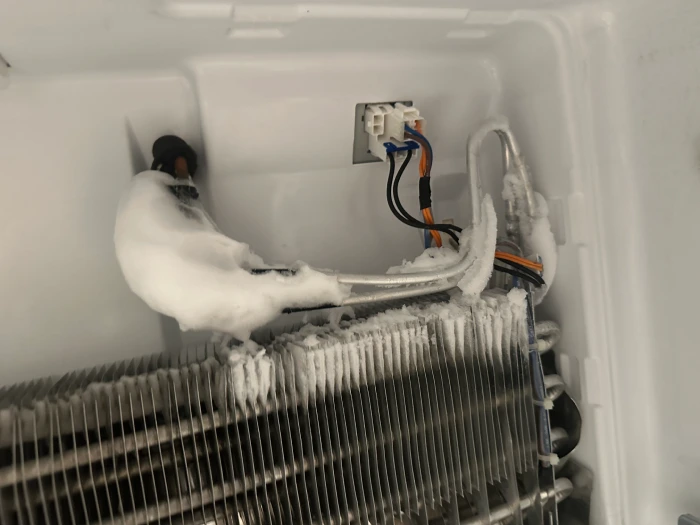
- The freezer won’t hold about 0°F, or you notice frost buildup on the back panel.
- You hear the valve buzzing but no water flows, or you see water leaking under or behind the refrigerator.
- The ice maker makes clicking or grinding noises, or the ejector arm is stuck mid-cycle.
- You have a built-in or high-end refrigerator, like Sub-Zero, Thermador or Viking, where panels and ice maker assemblies are harder to access.
A technician can test the inlet valve, ice maker module, thermostat, fans and control board to find the actual cause — instead of guessing and buying parts you may not need. If the ice maker problem is really a cooling problem, it’s better to find that out early, before food starts to spoil. If your fresh food section is also running warm, our guide on a refrigerator not cooling while the freezer works may help.
Ice Maker Repair in Charlotte
ProLine Appliance Repair fixes refrigerator and freezer ice makers across Charlotte, from Ballantyne and South End to Uptown, and in nearby towns like Cornelius and Concord. We work on Samsung, LG, Whirlpool, GE, Frigidaire, Maytag, Bosch and KitchenAid, as well as Sub-Zero, Thermador, Viking, Wolf and Miele. Our technicians are background-checked, and every repair comes with a 3-month warranty. Learn more about our refrigerator repair service.
How Much Does Ice Maker Repair Cost?
Refrigerator and freezer repair labor starts from $159.95, and a typical repair starts from $249.95 plus parts. These prices are based on our average repair ticket — the technician gives you the exact price after diagnosis, before any work begins. Our labor is priced below Appliance Blue Book. See the full breakdown on our refrigerator repair cost page.
Schedule Your Ice Maker Repair
Still no ice? Call ProLine Appliance Repair — Ballantyne: (980) 982-2424, 12124 Bobhouse Dr, Charlotte NC 28277; Uptown: (980) 888-8446, 227 W 4th St, Charlotte NC 28202. The residential service call is $69.95 and free with repair. You can also Book Online in a couple of minutes. We accept card, Apple Pay, Zelle, cash and check.